
(Considerations When Choosing A Silk Bridal Gown)
Few fabrics are more luxurious than silk. And few fabrics have the same ancient and widespread heritage, produced at large scale and exported across the world as early as 2700BCE. Precious and revered, its value in society has transcended geographical and cultural boundaries through time.
Silk is the fabric of emperors. The fabric of royals. It can distinguish those in authority, those of wealth and those who achieve. When a lawyer reaches the height of their profession, they ‘take silk’, and become entitled to wear silk robes. Academic degrees are presented to graduates in silk hoods. It is made into ecclesiastical robes and has featured in other ceremonial rites, from ancient Egyptian burials to modern-day weddings. As a bride, Lady Diana wore 25 yards of silk taffeta. It’s of no surprise then, that a silk wedding gown is the aspiration of many brides today.
“Throughout history, fashion has reinforced the notion that every bride is queen for a day, or at least Cinderella.” (The Way We Wed, Kimberley Chrisman-Campbell)
So, what does silk mean for you as a bride today? Let’s explore the history of silk and some of the considerations and challenges when choosing silk for your wedding gown.
The Silk Road
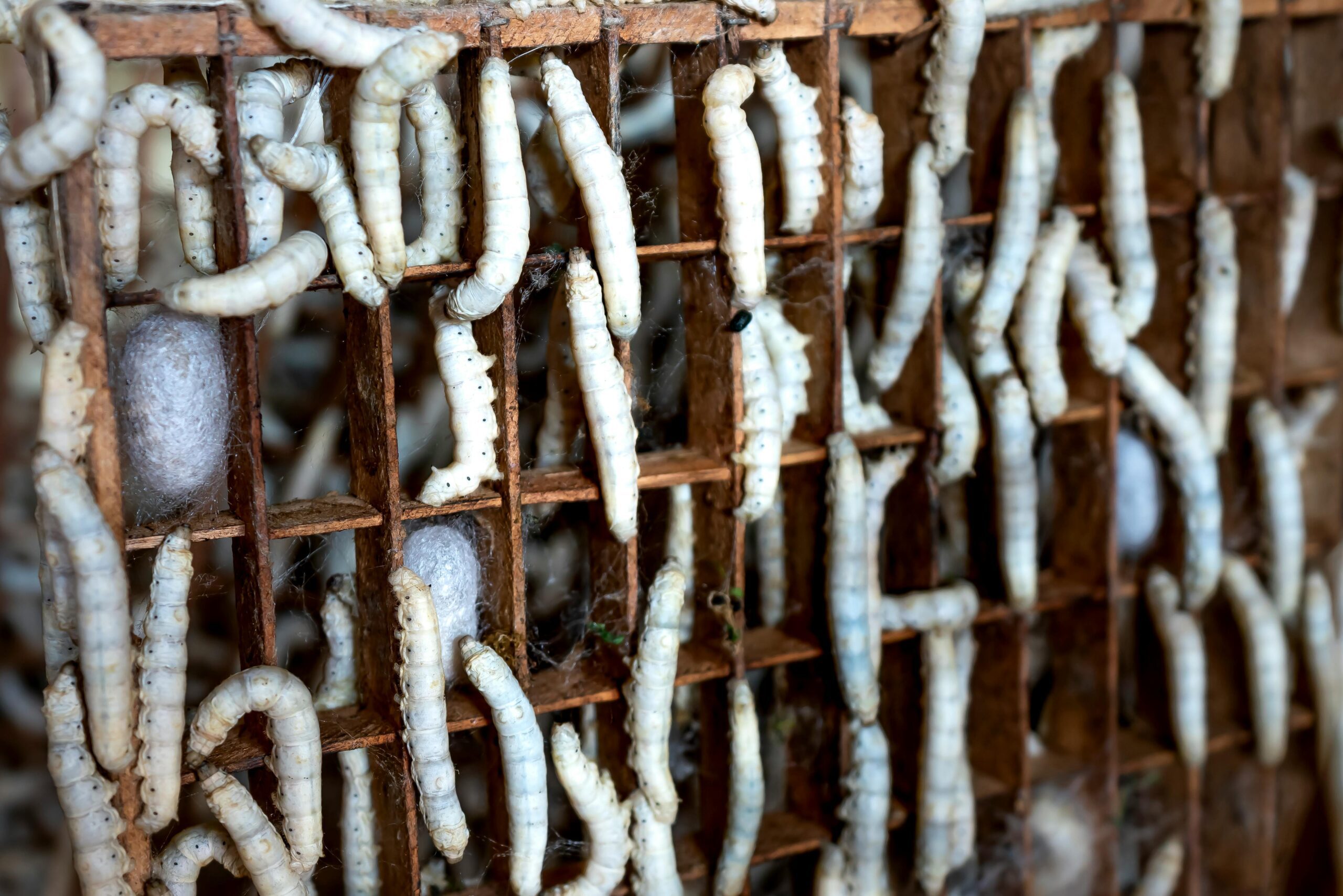
Sericulture is the farming practice of raising caterpillars, larvae of the Bombyx Mori moth. This flightless domesticated moth, bares little resemblance to its wild cousin, however. For centuries, humans have engineered its evolution for the purpose of farming. The ‘silkworm’ will build a cocoon by secreting and encasing itself with a long, continuous fibre, known as a filament. And a single caterpillar will work continuously for three days to secrete and spin a 900 meter long, unbroken thread. Almost one of kilometre of filament for a single cocoon.
This material gave its name to the Silk Road. An expansive trade network that traversed mountains, deserts, and seas for over 4000 miles. The silk road connected East Asia to India and Africa and was the means of trade between the Roman Empire and China and, later, between medieval Europe and China.
The Silk Road facilitated the spread of knowledge, religion and culture. Persia became a colourful and vibrant centre of silk trading between East and West and, despite China closely guarding its methods of production, the craft of weaving and dyeing silk flourished across the world. With the help of smuggling monks, the technology of sericulture developed, and thrived, in regions such as India and Italy.
“Travellers along the Silk Roads were attracted not only by trade but also by the intellectual and cultural exchange taking place in cities along the Silk Roads, many of which developed into hubs of culture and learning. Science, arts and literature, as well as crafts and technologies were thus shared.” (Unesco.org /silkroad/about-silk-roads)
Understanding Silk
There are many advantages and disadvantages of choosing silk. Understanding these will help you to make a more informed and confident choice. Lightweight and breathable, a thermal-regulator, moisture-wicking, hypoallergenic and mosquito-resistant… and of course, the enticing lustrous sheen. From the crisp rustle of taffeta to the softest of fine chiffons, there are multiple possibilities. But there are some characteristics of silk that need special consideration and thinking about the nature of your big-day can be helpful when assessing the suitability of silk.
Wedding Day Suitability
Creasing: A silk gown may not be practical when marrying abroad since silk creases heavily. This would pose a significant problem, on arrival to your wedding destination, after transporting the gown in tightly packed luggage. It would be your responsibility to ensure that a specialist steaming and pressing service is available on arrival.
Heat Sensitivity: The surface of silk fibres can scorch easily so should be ironed with a pressing cloth. This will also protect seam folds from acquiring an unwanted sheen. Avoid steaming a silk bridal piece yourself, unless confident in doing so, as mini travel steamers are prone to ‘spitting’. This can scorch and leave watermarks.
Water Marking: Likewise, if the gown is intended for a beach ceremony, silk may not be an appropriate choice. Sand moisture will watermark the hemline and train. This same consideration applies to Winter weddings here in the UK if you are moving between multiple venues, due to the impact of rain or ground moisture. But for a Winter wedding hosted under one roof, this would be no issue at all.
Shade Variance
Dying: Silk will dye very well. But as a biological fibre, with each fabric bolt produced by a different team of caterpillars, this does mean that dye consistency can vary across fabric bolts. This is important to know, when purchasing, particularly if the sample gown in question has colour detailing. Your actual gown, may have a subtle shade variance, so it is worth preparing for this notion to prevent any surprises at the point of collection. Shade variation is not a fault, it is simply a special characteristic of silk, making each dress truly unique.
When ordering cloth for a bespoke piece, a couturier will ensure that the required length is correctly ordered from one bolt, ideally the same one from which your colour swatch was issued. Some silks are supplied in sari-lengths so designers should be careful with this if more than one length is required. As shade consistency is not guaranteed.
Preservation
Staining: Its logical that since silk dyes well, it stains easily too. To protect the train of your silk gown, ensure that your dressing area is a shoe-free environment with no food, drink or make-up products present. You could have a wrist tape or bustle inserted into your gown to lift the train from the floor and keep it clean when outside or in places like the bathroom.
Acid Damage: Perspiration will damage silk. Sweat has an acidic PH value which will gradually break down the proteins and will, additionally, cause yellowing. Whether clammy or not, skin has an acidic residue from even mild perspiration, which then compromises the gown. It is therefore important to clean your wedding gown after the big-day, as soon as possible. To protect the at-risk underarm area, use a fresh pair of dress shields for every try-on and throughout the wedding. These simply adhere to the inside of the dress, and peel away after use. (Try our Sweatguard recommendation)
Mildew: Keep the storage location for your gown regularly aired, and remember to let your silk gown breathe after each try-on, to prevent mildew. For brides who live is small apartments, it is important to store your gown in a room separate from a bathroom or kitchen, away from steamier environments. Ensure that you use a breathable dress bag and avoid plastic coverings.
Sunlight: Being protein based; silk is susceptible to damage by ultra violet rays. Over time, sunlight will gradually break down the protein fibres and create holes around stress points such as fastenings, seams and hanger contacts. Therefore, keep your silk gown bagged on the run up to the wedding to protect it from general daylight, as not all UV rays are absorbed by glass. UVA rays will penetrate through. And, after the wedding, you could use a breathable bridal storage box for light, moth and mildew protection.
Cleaning
Washable: Silk is suitable for both dry-cleaning and water-based cleaning. However, hot water will harden silk so use a cool water temperature with a gentle, bleach-free detergent. The fabric must not be rubbed or wrung out as this will separate the threads and distort its weave.
Quick-Drying: Towel roll any moisture out of the silk and leave the gown to air dry away from a radiator so that the fabric will dry evenly, at the same pace throughout. This will prevent a watermark bleed. For this reason, silk is not suitable for spot-cleaning since the cleaned area will watermark when drying. If a small area of the gown becomes soiled, a full water immersion would be required so that the newly cleaned area can dry in tandem with the gown as a whole.
Alterations
Scarring: Keep in mind that silk fabric is subject to stitch-scarring. Therefore avoid any risk of a ‘let-out’ being required, when being sized for your gown. Finer silk fabrics will be French-seamed resulting in a twice stitched, narrow seam allowance, with very limited capacity for sizing up. Once a finished gown has been pressed, those heat-pressed folds become permanent. The surface of the pressed fibre is physically changed meaning that a let-out will reveal heat-scarring in addition to stitch-scarring.
Temperamental: Alterations to a silk gown require more confidence than other fabrics. So, ensure that you book with an experienced seamstress or couturier. The surface of silk will glide over the machines feed-dog a little too smoothly and it can also indent. Sewing with a tissue paper between layers will prevent this slippage but does slow the process and can impact cost. Silk can be prone to tiny snag lines too so a new needle should be used for each silk gown, usually a 70/10 universal for finer silks, though a 75/11 can sometimes work better for heavier weaves.

Ethics
It would be an oversight to disregard the ethical aspects of your bridal gown. The guilt-free fashion movement has an increasing consumer base and knowing how gowns are made, and from what, will enable you to make a better informed choice.
From an environmental point of view, silk is a great choice. It lends itself well to organic farming methods and the resulting fibre, being so absorbent, will colour very easily, requiring much less water and chemical dying than other fabrics. Being fully biodegradable means that end-of-life disposal has no long-term impact.
This, however, is in stark contrast to its impact on animals. To retain an unbroken thread, the cocoon must be unwound via a process known as stifling. This means boiling or steaming the cocoons with the caterpillars still alive inside.
“…When you dip the cocoon in boiling water or bake it with hot air, you’re killing the pupa inside. And huge amounts of pupa are killed in these ways to make the world’s silk. To make one pound of the lustrous, revered material requires about 2,500 or more silkworms.” (Quartz, Is it Unethical to Wear Silk? Marc Bain, 21.06.18)
Cruelty Free Silks
None-commercial Tussah and wild Tussah silk is spun from the broken, shorter fibres of a chewed cocoon. There is no stifling process, and the caterpillar can naturally chew its way out of the cocoon to emerge as a moth, therefore compromising the filament. The uneven nature of the ‘spun’ thread creates a more matt, slubbed texture and for this reason it is less frequently used in bridal gowns.
Ahimsa Silk (from the Sanskrit ‘none-injury’) was developed in India by Kusuma Rajaiah who was “heavily influenced by Mahatma Gandhi’s non-violent philosophy.” (Vogue India, Jasreen Mayal Khanna, 13.09.19) This is also a stifling-free method and is frequently referred to as Peace Silk or None-Violent silk. Despite Ahimsa silk being costlier and more time-consuming to produce than regular silk, it has become a popular choice for designers catering to a more discerning buyer.
“Ahimsa is the attribute of the soul, and therefore, to be practiced by everybody in all affairs of life. If it cannot be practiced in all departments, it has no practical value.” (Mahatma Ghandi)
Vegan Alternatives
The Vegan movement has spilled over onto the catwalk, with a revolutionary approach to plant-based fabrics. In 2019, Vogue reported that vegan fashion stock had increased by 258% across the UK and US. Tencel, rayon, milkweed pod fibre, lotus fibre, citrus fibre, soy silk and banana silk are all alternatives that can imitate the aesthetics of animal derived silk.
Additionally, modern polyesters are now a very accessible, attractive and affordable bridal alternative and whilst regular petroleum derived polyester is far from being environmentally sustainable, recycled polyester is much better. Recycled polyester based mikado, chiffon and tulle mimic traditional silk but with slightly different properties that result in a silk-like fabric that is crease resistant, stain resistant, easy to wash and does not water mark. This offers a practical alternative for a bride with an overseas destination wedding. For the bride who is vegan. Or the bride with a smaller budget, who aspires to the look and feel of silk, but without the price tag.
“47.4% said they would like to see more vegan verified fashion across all clothing ranges.” (PDF Report: The Rise of Vegan Fashion, The Vegan Society, 2021)
Labour
In places such as Uzbekistan and India, silk production can be negatively associated with exploitation and child labour. However, as Quartz magazine explains, in countries such as India and China “it still provides livelihoods to a large number of people. In rural areas of India, in particular, the work it offers can be invaluable, especially for women.”
Certifications to look for include:
The SA8000 Standard- The world leading social certification program which assesses against criteria related to child labour, enforced labour, health & safety, and collective bargaining rights.
Global Organic Textile Standards (GOTS)- The certification of organic fabric. This also safeguards workers from the harmful side affects of working with chemicals and pesticides.
Fair-Trade- A certification that supports the right to a fair wage and good working conditions.
Your Approach
Silk will certainly hold its place in the bridal market and on the aisle. How, and whether, you choose to wear silk as a bride will depend on a number of factors. The type of wedding that you want….and, of course, the gown budget available to you. But ultimately, what you choose to wear will be a testament to your own values.
Whether it’s the history and legacy of silk that attracts you… The cultural richness of a fabric belonging to our ancestors. The stories and romanticism of the silk road…
Or an interest in the new-to-market silk alternatives driven by the growing niche of ‘Conscious Fashion’. Tapping into the growing trend of cruelty-free clothing…
Or whether you relish the challenge of sourcing an alternative silk-like product by more practical and affordable means…
Consider your own personal values and how your gown selection can feed into this. Actively look for designers that provide fashion conscious options, and then find out where they are sold. When researching and booking appointments, ask boutique owners about their brands and question the fabric information and traceability. When trying on gowns, ask what they are made from. You, as a bride, may be paying the bill, but who and what is paying the true cost of your silk bridal gown?